In the spirit of being completely honest with strangers on the internet, I want you to know a few things about me right out of the gate:
- I am a 38-year-old from California with incredibly average surf capabilities.
- I work a boring job that pulls in a very moderate income.
- I am just as inherently selfish as every other surfer on the planet.
Despite having an embarrassingly ordinary life on paper, I have managed to pull off fifteen international surf trips and one year-long surf safari in the last twenty years. Most have been successful.
Why I wrote this guide
If I told you I wrote this extensive guide purely out of the goodness of my heart so that you don’t repeat my mistakes, I’d be lying. While I certainly don’t want a fellow surfer to waste two weeks of hard-earned vacation at a terrible break, blow their life savings on a bunk itinerary, or get taken to the cleaners by predatory locals, I have no real incentive to just hand over twenty years of hard-earned travel secrets to people I don’t know.
The truth is I’m hoping you get value out of this tactical guide and you’ll check out my real work (creative surf essays from my experiences on the road – link at end).
This guide contains the raw, unvarnished truths of international surf travel and the exact advice I wish someone had handed me when I set out on my first trip at age 18.
If you read through to the end and still have questions, my direct contact info is at the bottom. Shoot me a message.
Table of Contents
Part 1: Pre-Planning: What Everyone Gets Wrong Before They Even Start
Part 2: Planning: A Logical Framework for A Successful Trip
Part 3: Budgeting: The Psychology of Economics & Money Management
Part 4: Gear: Myths, Mistakes & Must Haves
Bonus: Additional Tips from 20 Years of Traveling
Part 1: Pre-Planning
My first surf trip was at a dedicated camp in Panama and it was a big success. I took my second the following year and it didn’t nearly as well. With an inflated ego, I ventured out on my own to Costa Rica and made several rookie mistakes. One of them was a misjudgment on my own surf abilities. I thought I wanted – and could handle – critical waves with open barrels. On my first paddle out I realized I had bit off more than I could chew. Surrounded by much better surfers, I watched others getting shacked while I got worked on the inside, barely able to make it out.
On following trips, with my ego more in check, I sought out mellower waves that matched my skill level and although I continued to make travel mistakes, I had a much better time in the water. I now look for destinations with waves that challenge me but aren’t so far outside my comfort zone that I can’t surf them or risk injury if I do.
Truth #1: The fastest way to ruin a surf trip is to lie to yourself about your skill level.
I wish I had taken an honest inventory of my own surf ability before assuming the only reason I wasn’t getting shacked on a regular basis was because my local wave wasn’t pitching hard enough.
While it’s healthy to be optimistic, it’s dangerous to be delusional. Be honest with yourself about the type of surf you’d actually enjoy before pulling the trigger on a hollow tube breaking over shallow reef.
Setting Expectations
Truth #2: The second fastest way to ruin a surf trip is to enter it with unrealistic expectations.
The Happiness Equation:
Happiness = Reality – Expectations
Expectations (The Part We Can Control)
Great camera angles, slick editing, and surfers who make the impossible look easy wildly inflate our expectations of destination surf breaks.
You’re likely familiar with the clip of Cape St. Francis (now known as Bruce’s Beauties) in The Endless Summer where the surfers come over sand dunes to find a perfectly peeling and empty right-hander. The narrator tells us the wave breaks like this perfectly for 300 days a year.
While it made for a spectacular climax in one of the greatest surf films ever, it’s far from reality. I went to that surf break in South Africa a few years ago and unlike its neighbor Jeffries Bay, Bruce’s only breaks a couple times a year when the swell angle is just right. The paddle out is tough, the water is cold, and you can bet your bottom dollar that when it’s on, the locals will be there before you.
Key Takeaway: By nature of the attention economy, surf media sparks our imagination and inflates our expectations. We need to reel ourselves back down to reality and remember that even if we go at peak season, it isn’t always firing and glassy… and these days… it’s probably also crowded.
I’m as guilty as any surfer of frothing before a trip, but have learned to temper my expectations in service of planning a successful surf adventure.
Here are the reality checks I run through to realign my expectations with reality and hack the Happiness Equation for myself:
- Remember Weather is Unpredictable: A lot has to align for a break to get good: swell, wind, tides, and crowd. Later in this guide I provide tips on how to maximize for these. For now it’s important to remember that luck has a lot to do with getting these conditions to align during the 1-2 week period you’re on your trip.
- Know That Crowds Are Real: Unless a trusted personal contact takes you to a “secret” spot, its safe to assume the lineup will be at least as crowded as your local break… and you won’t have local status. Don’t worry, you’ll still get waves – but temper those expectations a tad.
- Expect The Inevitable Travel Friction: Do not expect logistics to flow smoothly. If you’re traveling from the developed world into the less-developed, things will not run as smoothly as you’re accustomed to. Delayed flights, missed ground connections, or a flat tire on a dirt road are par for the course. Simply knowing these are part of the trip drastically reduces your stress when they inevitably arise.
NOW, with the hard part out of the way, let’s get into the logistical and economic details of planning a successful first trip.
Part 2: Your Planning Framework
The Non-Surf Factor
On my very first trip to Panama I had my bubble burst and learned that surf is only one part of the trip. Coming from Southern California, it was my first real look at the day-to-day life of people living in a developing country. While I caught great waves, I also got lost on the streets Panama City, had a conversation with a cowboy in broken Spanish during a bus ride, and fed someone’s pet monkey in the local village near our surf camp. Twenty years later these memories are more vivid than the waves I surfed and contributed just as much to my stoke from that first trip.
My Recommendation: In addition to a destination with waves that fit your skill level, look for a place that is new and interesting with a fair serving of the unknown.
Ask Yourself: If it’s flat or the winds are onshore for four days straight, does this place still offer an experience that makes the flight ticket worth it?
When you tie your enjoyment to the broader cultural experience, you insulate yourself from bad weather events and significantly increase the overall success of your journey. Remember, this is your first trip, not your last. There’s more to surf travel than wave count.
How To Choose Where To Go
To keep myself from going crazy I move from broad into specific in this order:
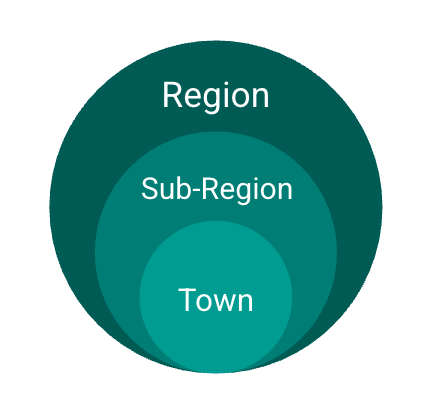
Selecting The Right Region
Narrowing down where to go from all the options is one of the hardest parts of planning for me. To prevent selection paralysis I start with a region and then get more specific from there.
Here are the classics based on region:
| From | To |
| US | Central America |
| Australia | Indonesia |
| Europe | Morocco |
These “classics” check all the boxes:
- Proximity keeps travel relatively easy.
- Favorable exchange rates keep budgets manageable.
- They cross major cultural and economic borders which provides for a more fulfilling experience.
- They are well traveled by surfers so you get a novel experience without having to be a trailblazer which sounds romantic but in reality is quite challenging (and not a good call for your first surf trip).
Remember: This is your first surf trip, not your last. You don’t need to discover a new wave or experience the absolute pinnacle of human travel on your first try. I’ve built up to more and more remote destinations over the years and am glad I did.
From Region to Sub-Region
After deciding on a region I use tools like Google Flights to compare prices to major hubs in that region. This helps me see what’s feasible and usually results in 3-4 potential sub-regions to explore.
With this short-list of sub-regions I check seasonality to make sure I don’t accidentally go in the off season.
Notes on Seasonality
- The Obvious: Don’t go somewhere it’s flat, like Morocco in July.
- The Not-So-Obvious: Depending on your skill level you might not want to go at peak season either. Often times I look for shoulder-season months where it’s highly likely there’s swell but it isn’t outright pumping and swarmed with semi-pro surfers on strike missions.
- Avoid: Do a quick check to avoid major holidays and pro, semi-pro, or qualifying events. This can kill your stoke and your budget.
From Sub-Region to Coastal Town:
Diversity of Breaks
I always look for a destination with a variety of breaks nearby. In many places I’ve traveled to in Indonesia there’s only one or two breaks accessible by foot, the others require boat rides or long drives. If there’s only one game in town and it’s too big, too small, or the swell direction isn’t right… it’ll put a damper on your trip. Plus, it concentrates all the surfers in one area.
For your first run, I recommend going somewhere with multiple setups.
When doing your research, ask these two mandatory questions about a break before booking:
- Are there multiple breaks to choose from within a 20-minute radius? You want a zone that offers variety so you aren’t stuck on the sidelines if the primary break is too big or flat and you might enjoy a little diversity in wave type too.
- What is the substrate? If you’ve only ever surfed beach breaks, limiting yourself to only a shallow reef break is a risk for injury. Find a region that offers something you know and something new so you have options.
A Practical Note On Logistics
My friends will tell you I’m naturally relaxed, a laid-back dude, “super chill bro”… but like everyone else I still get stressed about making flights and passing through immigration. So when I travel I do my best to reduce the number of connecting flights and ground transfers. Depending on your ambition, you’ll have to balance ease of travel with crowds. Generally, the easier it is to get there, the more surf tourists there will be.
Recommendation: For your first expedition, the simpler the better. Every moving part or connection is an added risk and stressor. Consider your tolerance levels and book accordingly.
The Surf Camp Spectrum
One of the easiest ways to keep your first trip simple is to let someone else handle the friction of logistics. Surf camps aren’t always viewed as the sexiest or most adventurous option, but for a first-timer, they lower the learning curve. From my experience, it’s a very good option. If the camp doesn’t outright handle airport pickups and local transfers they’ll help you figure it out and will be available in the event things don’t go as planned.
However, surf camps are directly proportional to your budget, and you need to understand the trade-offs:
- The Budget Camp: Perfect for instant community and solo travelers on a tight budget. The trade-off? You will be following the camp schedule, piling into a truck or van with other surfers of varying skill level, and surfing the same crowded breaks as every other budget camp in the area.
- The Tailored Camp: A higher financial barrier to entry, but it buys you customized resources. You’re paying for dedicated surf guides, boat access, a more remote area, and / or all of the above.
If your budget doesn’t already make this decision for you, consider whether you want a more social experience (areas with high density of camps) or a tailored surf guide (remote camps with boat service to various breaks).
Part 3 – Money Management
I’ve found the money factor on a surf trip to be a much bigger deal psychologically than economically. Here’s what I mean:
The Psychology of Travel Economics
When you’ve spent months saving it’s natural to be watchful over your nest egg and it’s smart to try to get as much bang for your buck as possible. But… there’s an important distinction between being a savvy spender and stingy traveler. In my experience, haggling over the small stuff creates more stress than its worth, saving a surprisingly small amount of money and giving surf tourists a bad rap with local hosts.
Putting Costs Into Perspective
I plan out my budget in a spread sheet and compare actual vs planned after the fact. I’m not suggesting you need to be as meticulous as I am (but if you plan to do more surf trips in the future it’s not a bad idea). For now, just take the insights I’ve gained and apply them as needed to your planning.
Key Learning: The 80/20 Rule of Surf Travel Expenditures
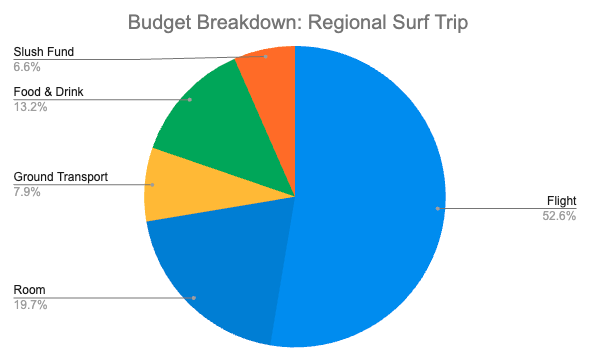
When I break my spending down by category from past trips I find a similar pattern: 80% of my spend is on flights and accommodations. The remaining 20% is split between food, ground transportation, and a “slush fund” (more on this later).
Why is this important?
By far the biggest opportunity to cut costs is in finding a good deal on the flight and place to stay. The rest is such a small percentage of the total, it’s barely worth stressing over.
To get the most bang for my buck, I spend most of my effort optimizing these two areas:
Selecting Flights
Timing – For most international flights the best window for purchasing is 3-4 months in advance.
Board Bag Fees – Airlines are notoriously unclear about their board bag fees. It pays to do careful research ahead of time. I almost always find that out the three airlines flying the route I need, one has much lower fees for sports equipment. Just make sure you actually do the research and don’t make assumptions…
Here are some specific things to check for when reviewing airline sports equipment policies:
- Weight Limit – always weigh your board bag before you go to airport.
- Size Limit – airlines love to do the “items larger than combined dimensions L x W x H will be charged an additional handling fee”. It’s a pain in the ass, but you can use a measuring table and do some elementary math to make sure you know where you fall.
- Board Count – less common, but a killer when they get you… sometimes airlines charge per board instead of per bag.
- Pre-Registration – also less common, but highly risky if you miss it – some airlines require you to register sports equipment ahead of time so the airline can accommodate it.
Tip: LLMs do a pretty good job of comparing surfboard bag fees, but you need to specify the route and the airlines you’re considering. Then… you need to double check the actual airline website to make sure you get the details right.
Attendant Relations
The person checking you in at the counter has a lot of leeway to let you off easy or enforce additional penalties. My approach is to know where I stand going in and expect they’ll be hitting me with the full fee. If I get lucky and they decide not to measure or count boards, I take that as a bonus. I always greet them with a smile and wait patiently. If you find yourself on the cusp of weight or size limits and the attendant is trying to decide whether or not to enforce it… they’ll be more lenient to the person who is making their life easier than the nervous and defensive surfer ready for a confrontation. If you find yourself barely over the limit of the standard sports equipment fee (like excess weight), it doesn’t hurt to ask, “Can you waive the extra fee this time? This is my first surf trip.” You may get lucky…
Choosing Accommodations
For most travelers, having your accommodations locked in ahead of time is worth paying a little bit extra for. You know the final cost ahead of time, you don’t have to worry about searching and moving once on the ground, and you can focus more on enjoying the trip. On your first trip, that’s not a bad approach.
If you’re on a shoe string budget, here’s my advice: Instead of locking yourself into a two-week block at a potentially inflated internet rate, use the 3 day arrival rule: book a cheap, centrally located homestay or surf hostel for just your first few nights to acclimate. Once familiar with the area, you can talk to other surfers, scout the local breaks, and negotiate directly with the managers of smaller, lesser-known guesthouses. In-person rates in surf towns are almost always significantly lower than what you’ll find on a booking platform. This also gives you the freedom to pack your board bag and move down the coast if you find that another area is better suited for your taste. Note that you may need to pay in cash to get these discounts.
Maximizing The Remaining 20%
My advice: Try not to worry about it on your first trip; There’s enough to juggle already.
You can eat cheap and elect to forego on boat or car trips to other breaks if you need to… but if you’re considering these in order to save money you can ask yourself these questions:
- What percentage of my total budget is this expense?
- How long will it take me to make back this amount of money when I’m back home?
Enjoy your trip… you’ll have plenty of opportunity to work hard and save money when back home.
On The Ground: The “Tourist Tax” vs Getting Scammed
If you are coming from a developed nation and traveling to a developing country with board bag, everyone on the ground knows you have disposable income. You are on vacation to spend money; they are working to provide for their families. Because you don’t speak the language and don’t know the local landscape, you are going to pay a tourist tax at some point.
Don’t take it personally. It’s not an insult to your intelligence, and it’s not a personal scam—it’s just the cost of doing business. If you have the time and the funds to go on a dedicated surf trip, you are in a more privileged position than 99.9% of the of the rest of the world. You don’t need to feel guilty about it, just factor that reality into your mindset, pay the slight premium gracefully, and remember that you won’t remember the extra three dollars you spent on a taxi when you’re back home explaining your neck tan to colleagues at work.
The Unavoidable Weight of The Real World: I still have trouble balancing the messy reality that everyone is born into different physical and socio-economic situations and we have no control over it. One of the great things about traveling is that it forces me to confront this truth of life which is deeply uncomfortable. For some reason I can’t explain, this reality makes me feel more alive than living in my safe bubble back home and despite its discomfort I keep coming back.
In your travels you’re likely be hit with this discomfort too. I have no antidote for you. For me, trying to accept it and holding true to my values as best as possible along the rollercoaster has been a reasonable guiding light. I’ve found that a small portion of bad actors try to use this apparent discomfort to scam me, and in the next section I have some practical advice to help you avoid them.
Avoiding Scams
In most surf destinations scams are rare and easy to spot if you know the telltale signs. I was scammed twice in my early years of travel, both by taxi drivers charging extreme rates (3x the going price). Since then I learned that a little preparation in advance will help me spot a bad actor (and I’ve avoided several successfully).
It sounds a little nerdy, but these two prep steps have worked for me:
- Ballpark Research Ahead of Time: Before I get on the flight, I spend a few minutes figuring out the baseline local cost of the main transactions I’ll be making: taxis and a standard local meal. I also do a quick Google search for common tourist scams in that specific region. If you know a cab from the airport to the coast usually costs around $20, you won’t panic if someone asks for $22, and you’ll know exactly when to walk away if they demand $60.
- The Pre-Run Script: I mentally run through the exact scenario of an aggressive driver or vendor throwing an egregious rate at me, and I script my reaction. The goal isn’t to call them out or report them to security (who may or may not be in on it). It’s just to avoid potential trouble and interact with the much higher percentage of honest vendors. The script is simple: take a breath, smile, say “no thanks,” and walk toward another vendor. Having that pre-loaded script prevents you from making emotional decisions on the fly. If your gut tells you an interaction isn’t right, trust it. A trustworthy person won’t mind if you take an extra second to think it over. If they’re trying to rush or pressure you, that’s your red flag to use the script and walk.
How Not To Get Robbed
As my dad likes to say, “Keep the honest people honest.” Most petty theft is opportunistic and if you’re moderately sensible it’s easily avoidable.
If you’re drunk and brandishing cash or leave your wallet hanging out of your back pocket, you’re an easy target. My guess is, if you’re reading this that’s not you and you have little to worry about. But amongst the planning and excitement of the adventure you may fail to notice people eyeing you as you’re texting on an iPhone 16 while listening to reggae in a pair of Beats. You may not realize that those electronics would make for a nice pay day for someone who earns less in a year than you make in a week.
You get it: Be thoughtful of your surroundings.
The Value of A Buffer Fund
A non-obvious but “duh” once you hear it tactic I now employ is the buffer fund aka slush fund. In terms of money psychology it’s worth five times its actual value in stress reduction.
Before every trip, I set aside a specific, untouchable chunk of cash – usually 5-10% of the overall budget, or a flat $200 – that I fully expect to lose to the travel gods.
In twenty years of traveling, I’ve almost never spent the entire buffer, but simply knowing it exists completely changes how I make decisions on the ground. If you don’t have a buffer, a sudden $50 ding repair or an unexpected $40 cab ride because you got on the wrong train will chap your ass. But if you know that’s already accounted for in your slush fund, you won’t lose any sleep over it.
Part 4: Gear Myths & Mistakes
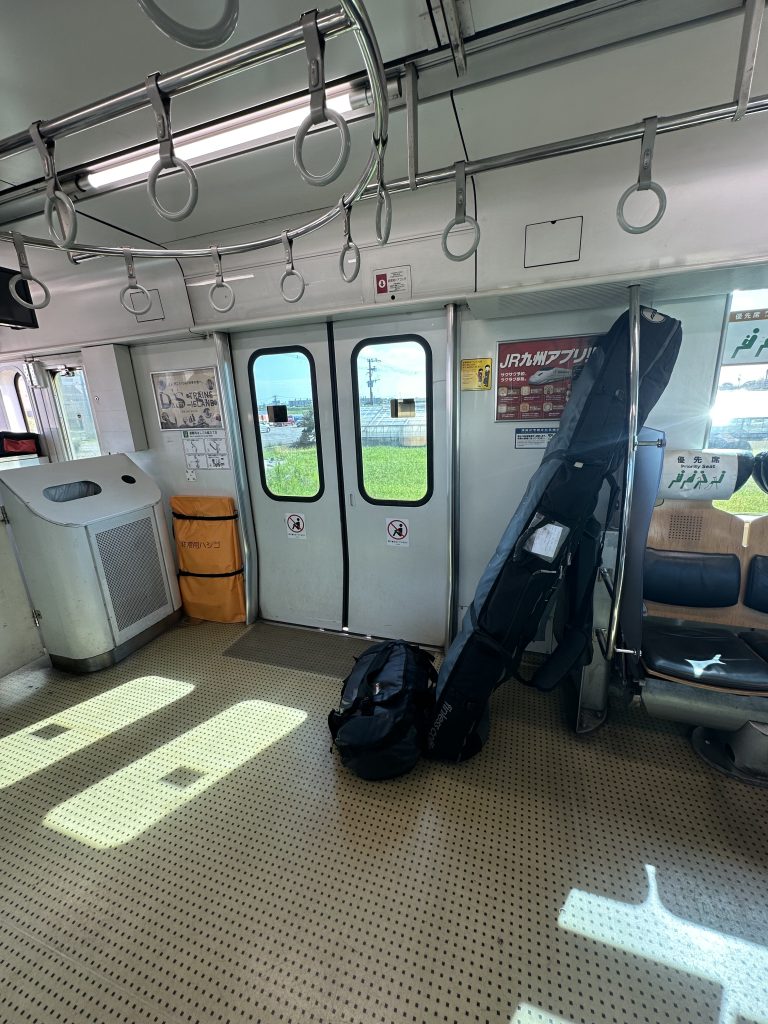
Rent or Bring: Why I Suggest Taking Your Own Board
If your surfing skill is anywhere above a baseline beginner level, I highly recommend traveling with your own surfboard.
The last thing you want to do on your first trip is spend your limited time in the water trying to learn the quirks of a new board while simultaneously trying to figure out a new wave. Because the vast majority of surf travelers bring their own equipment, rental shops almost exclusively stock big foam boards or clunky, ultra-durable plastic pop-outs meant for surf schools. If they do have high quality boards the rental cost for a week will be more than your board bag fees.
Should I buy a new board for my trip?
I don’t recommend it. Here’s why:
- You’ll be trying to learn the quirks of your board on unfamiliar waves. On a week long trip you don’t want to sacrifice the first three sessions familiarizing yourself with the new board. If your trip is just too good of an excuse to not buy a new stick, then get it a couple weeks ahead of time and dial it in before you head out.
- Between travel, unfamiliar breaks, and an unpredictable crowd, chances of board damage are high. I hate to see a brand new board with a ding… and that might put a damper on your trip.
Leave The “Step-Up” Up Home
Specifically for your first surf trip, a single surfboard is completely sufficient as long as it fits the general wave of your destination. If you do decide to pack a two-board bag, take your absolute favorite daily driver and a small-wave board with a bit of extra foam. Unless you’re in the tiny minority of first time surf travelers who absolutely love pumping surf, it’s much more likely that you’ll need a small wave board than a big wave board.
Repairs: Keep It Minimal
You do not need an extensive ding repair kit. All you need to travel with is one small tube of solar-activated resin (like Solarez) and two small squares of sandpaper to keep your boards watertight.
For anything beyond a simple solar cure you’re better off heading to the local ding repair shop (and doing it immediately).
Tip: If you have to go to the ding repair shop let them know you’re only in town for a week and this is your go-to board. If they’re anything less than certain about a quick turnaround, offer to pay extra. Here’s where that slush fund comes in handy to prevent you from having to ride a soft top on the best session of the trip.
Accessories
I used to over pack because I didn’t know what I needed. Now I do and my bag is about 25% lighter which makes a big difference when hauling it up stairs, across airports, and loading into cars, buses, and trains.
My Advice: Leave the extras and emergency stashes behind. On my first few surf trips I covered all the “what ifs” with extra wax, two backup leashes, and about a gallon of sunscreen. I quickly realized that the overweight baggage fees and swamp ass from lugging all of it around with me was a higher cost than the reassurance of knowing that just in case I broke two leashes I’d have a third.
Here are 3 hard truths I’ve learned about backup gear:
Truth #1: If you’re with a group, you can just take one extra leash, bottle of sunscreen, and set of fins for the crew. One person out of four might need it.
Truth #2: Wherever you’re going for your first surf trip, there will be a surf shop. It might just be a local selling out of his living room, but they’ll have what you need.
Truth #3: Surfers leaving while you arrive will be happy to offload the extra gear they brought and didn’t use.
You will likely pay a small premium for these goods due to the remote location, but it’s rarely more than a 50% markup. Even if it’s double the price – the absolute highest markup I’ve ever seen in 20 years of travel – it’s better than carrying it around. And again… it’s highly unlikely that you will actually need it.
Clutch / Overlooked Travel Items
While you want to pack light on the gear, there are a few odd, non-surf items that take up minimal space and can be a game changer:
- Day Bag: I use a light day bag to give my board(s) extra protection inside my main travel bag and it’s very handy for day trips once at your destination.
- Golf Ball: When you go from surfing two hours a week at home to paddling five hours a day for multiple days straight, your shoulder will feel it. A small hard ball between a hard surface and a knotted back can work wonders.
- Plastic Bags: I carry 3-4 small zip-locks, 1-2 big ones (one gallon), and a couple grocery bags. They’re cheap, versatile, and absolute life savers. Whether you need to keep the wet in, the water out, or just stash a snack… these can be life savers when in a pinch.
- Electronic Key Stash: If you rent a car on the ground, you will likely be handed an electronic key fob that is not water proof. Stashing your electronic key in the wheel well or on top of a tire is usually not the best idea – local thieves in surf towns know exactly where to look. Do a quick search online beforehand to see how other surfers handle vehicle security at your specific breaks. Get a waterproof key bag if needed.
Here’s an annotated version of my packing list:
Google Sheets: Surf Trip Packing List
Bonus: Additional Tips
Here’s a few other tips I’ve learned over the years that you might find helpful. If you still have questions, shoot me a message via the contact info provided at the end.
Travel Insurance: Buying Peace of Mind
I like to think of travel insurance as paying a premium for peace of mind. If an insurance policy reduces your baseline anxiety and allows you to enjoy the trip more, then it is entirely worth it – even if you never have to use it (and hopefully, you don’t).
If you decide to buy travel insurance, do not just blindly click “accept” on the cheapest policy. Grab the text of the fine print, plug it into your favorite LLM, and explicitly audit it with two questions:
- Are adventure sports, specifically ocean surfing in a foreign country, covered under medical evacuation?
- What is the exact redemption and reimbursement process if I need to use a local clinic?
You might be surprised at the massive gap between how travel insurance is marketed on a slick website and the actual legal exclusions buried in the fine print. Know what you’re getting before you pay.
ATMs & Currency Conversion
If you’re budgeting (even roughly) you can calculate how much cash you need. I err on the side of taking out a little more than I need. Having to eat a fee from your bank and the local ATM doesn’t taste good. The fewer ATM pulls the better. I always hit the ATM at the airport just outside baggage claim because I know there will be one there, they are much safer than those on the street in tourist hubs, and I often need cash for ground transportation.
If you just need a small amount of cash (for example if you’re at an all-expense-paid surf camp) then converting currency at the airport is a better bet. You won’t find a better rate outside the airport.
Most relatively developed places now have ATMs and accept credit cards, but I recommend doing a quick check before you go so you’re prepared.
Also note that vendors accepting credit cards often charge you the processing fee. It’s usually 2% and a minor cost, but if you’re really optimizing your budget it’s something to keep in mind.
A Simple Side Adventure
When I’m on a long drive I like to ask the driver to stop for food. I make it clear that I want to go to a local place – something they like to eat – and that I will pay for their meal. From Central America to Africa and China (yes there’s surf in China), this has resulted in many great meals at local restaurants off the tourist track for memorable experiences. Usually the driver is pleasantly surprised and it can turn an ordinary drive into a lasting memory.
Have more questions?
Message me on Instagram @stoke_o_nomics or email mizu@stokonomics.com
Find more of my work here: Stokonomics
Happy travels!